You have to meet a number of requirements to enter the European market. Buyers likely have additional requirements, and they may ask for certificates. Requirements for herbs and spices in Europe are usually about consumer health and safety, but environmental and social sustainability are also becoming more important. If you want to prepare for new legislation and requirements, you need to monitor the market on a regular basis.
1. What are mandatory requirements for spices and herbs?
Most mandatory requirements for importing herbs and spices (and food in general) are related to food safety. The European Commission Department for Health and Food Safety is responsible for the European Union’s policy and for monitoring the implementation of related laws.
Official food controls
Food imported into the European Union (EU) is subject to official food controls. These controls include regular inspections that can be carried out at import (at the border) or later on, once the food is in the EU, such as at the importer’s premises. The control is meant to check whether the products meet the legal requirements.
An important element of this legislation is that “all food businesses outside Europe, after primary production, must put in place, implement and maintain a procedure based on HACCP principles”. This does not need to be guaranteed with certificates or official controls. However, it shows that an HACCP plan is a key element in the quality management systems of companies aiming to become successful suppliers to the European market.
Non-compliance with European food legislation is reported via the Rapid Alert System for Food and Feed (RASFF). In 2024, 277 issues with spices and herbs were reported in the RASFF. This was slightly higher than the 275 issues reported in 2023. The most common issue was exceeding the Maximum Residue Limits (MRLs) for pesticides. The second most common issue was plant toxins, followed by salmonella as the predominant microbiological contamination.
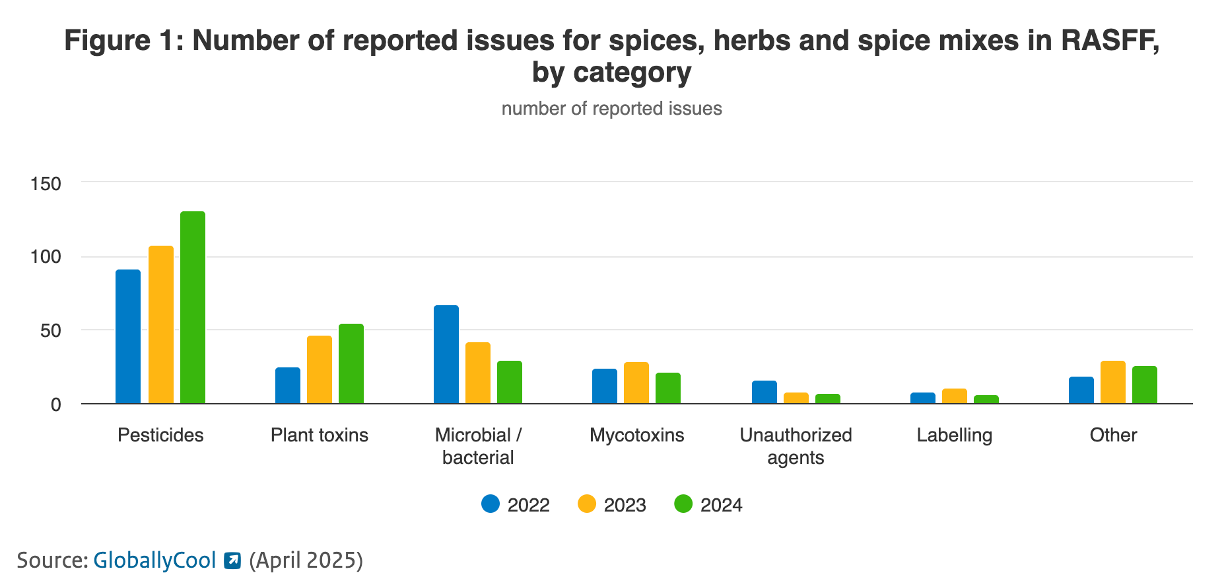
The main developments visible from Figure 1 can be explained as follows:
The rise in issues relating to pesticide residue is due mainly to problems with shipments of cumin from India and black pepper from Vietnam. Cumin from India has been subject to stricter conditions since 2023, with an increased testing frequency. This led to a high number of interceptions, which increased the frequency to 30% in January 2025.
The rise in issues relating to plant toxins is due to issues with oregano from Türkiye and cumin from Türkiye and India. These three product-origins are also subject to increased testing frequencies.
Non-compliance leads to stricter conditions
If imports of a certain product from a specific country repeatedly show non-compliance with European food legislation, the frequency of official controls at the border will increase. These products are listed in Annex 1 of the regulations on the temporary increase of official controls and emergency measures. One example is spice mixes from Pakistan, which are frequently checked due to their increased risk of aflatoxins (aflatoxins come from mould and therefore are part of the mycotoxins group in Figure 1).
Table 1 lists all the herbs and spices that are subject to temporary increases in official controls at entry to the European Union, including the relevant hazards and origins. The last column, ‘notes’ gives more information on specific measures, as they tend to change over time due to changes in risk perceptions. For example, the spice mixes from Pakistan experienced a decrease in the frequency of controls (from 50% to 30%), due to improved test results and an associated reduction in food-safety risks.
| Country of Origin | China | India | Pakistan | Sri Lanka | Türkiye | ||
|---|---|---|---|---|---|---|---|
| CN Code and product name | Hazard | Notes | |||||
| Sweet peppers (Capsicum annuum), ground | Salmonella | 10 | Stable | ||||
| Nutmeg | Aflatoxins | 30 | Stable | ||||
| Capsicum peppers, ground | Aflatoxins | 10 | 50 | For India, since 2023; for Sri Lanka, since January 2025 | |||
| Cumin, all types | Pesticide residues | 30 | Since 2023, but frequency increased to 30% in January 2025 | ||||
| Vanilla | Pesticide residues | 20 | Since July 2024 | ||||
| Cloves | Pesticide residues | 20 | Since July 2024 | ||||
| Spice mixes | Aflatoxins | 30 | Stable, but frequency decreased from 50% to 30% in 2024 | ||||
| Cumin, all types | Pyrrolizidine alkaloids | 0 | Previous frequency of 20%, increased to 30% in 2024, before Turkish cumin became subject to the stricter EU regime in January 2025 (see Table 2). | ||||
| Dried oregano | Pyrrolizidine alkaloids | 30 | Frequency was stable at 20% for a long time, but increased to 30% in January 2025 |
Source: (April 2025), based on EUR-Lex
The main developments visible from Figure 1 can be explained as follows:
Another table in EU Regulation 2019/1793 lists products that have special import conditions because of contamination risks. Annex 2 gives special import conditions for food consignments that:
consist of products that come from multiple origin countries, or
contain two or more ingredients from Table 2 (below), and the ingredients make up more than 20% of the total product.
For these consignments, a frequency of identity and physical checks as a percentage is applied to make sure that contamination hazards remain under control. In other words, for the products in Annex 2 (Table 2 below), the import conditions are stricter than for the products of Annex 1.
Table 2: Spices and herbs subject to special conditions for import to the EU (frequency of identity and physical checks, in %)
| Country of Origin | Brazil | Ethiopia | Indonesia | India | Sri Lanka | Türkiye | |
|---|---|---|---|---|---|---|---|
| CN Code and product name | Hazard | ||||||
| 0904 - Pepper of the genus Piper, Capsicum or Pimenta | Aflatoxins | 30 | |||||
| Pesticide residues | 20 | ||||||
| 0904 11 00 - Black pepper | Salmonella | 50 | |||||
| 0904 21 10 - Peppers of the genus Capsicum | Aflatoxins | 50 | |||||
| 0904 21 90 – Dried Capsicum or Pimenta, neither crushed nor ground (only a few products) | Aflatoxins | 50 | |||||
| 0904 22 00 - Peppers of the genus Capsicum (only a few products) | Aflatoxins | 50 | |||||
| 0905 - Vanilla | 0 | ||||||
| 0906 - Cinnamon | 20 | ||||||
| 0907 - Cloves | 0 | ||||||
| 0908 - Nutmeg | Aflatoxins | 50 | |||||
| 0908 - Nutmeg, mace, cardamom | Pesticide residues | 30 | |||||
| 0909 - Seeds of anise, badian, fennel, coriander, cumin, caraway, juniper berries | Pesticide residues | 20 | |||||
| 0909 - Cumin | Pyrrolizidine alkaloids | 30 | |||||
| 0910 - Ginger, saffron, turmeric (curcuma), thyme, bay leaves, curry and other spices | Aflatoxins | 30 | |||||
| Pesticide residues | 20 | ||||||
| Curry leaves | Pesticide residues | 50 |
Source: (April 2025), based on EUR-Lex
Recent changes in frequencies include the following:
Control of pesticide residues
Regulation (EC) No 396/2005 sets maximum residue levels (MRLs) of pesticides in or on plant-origin food and feed. The MRL is the highest amount of pesticide residue legally permitted in or on food products when pesticides are used. Products exceeding these levels are taken off the European market. In 2024, 47% of all issues reported in the RASFF related to excessive pesticide levels or traces of illegal pesticides.
In 2024, the most frequently reported pesticide issues were:
Chlorpyrifos 40 issues (30%)
Pesticide cocktails 35 issues (27%)
Ethylene oxide (EtO) 16 issues (12%)
Others 40 issues (30%)
A cocktail is a mix of two or more pesticides, often including Chlorpyrifos and others, such as Anthraquinone, Carbendazim, Chlorfenapyr, Chlorothalonil, Clothianidin, Thiamethoxam, Tolfenpyrad, Triazophos or Cyromazine.
Dehydration factor - When assessing MRLs, the pesticide residues found in dried products must be compared to fresh products. In the case of dried products, Article 20 of Regulation (EC) No 396/2005 allows the concentration caused by the drying process to be considered when determining the MRL. To have a harmonised MRL assessment, the European Spice Association (ESA) has set dehydration factors for dried spices and herbs. This means that the pesticide limit fixed in the Regulation for the fresh product should be multiplied by the dehydration factor. The dehydration factors for the various spices and herbs vary from 3 (for dried garlic) to 13 (for coriander leaves).
The EU regularly updates its list of approved pesticides (Annex 1). In 2022, the European Commission adopted proposals to reduce the use and risk of chemical pesticides by 50% by 2030 (SUR). However, this Sustainable Use of Pesticides Regulation (SUR) plan was withdrawn in February 2024, after being rejected by the European Parliament in November 2023. At the moment of writing (March 2025), the European Commission was still developing a more balanced approach and updated regulation.
Synthetic pesticides not allowed in organic production
The use of synthetic pesticides is not allowed in organic production. Very low residue levels (often 0.01 parts per million) may be tolerated, but only if there is proof that the presence of the pesticide is due to cross-contamination, rather than to illegal pesticide use.
Control of contaminants
Food contaminants are substances that have not been intentionally added to food. They may be present in herbs and spices as a result of production, packaging, transport, holding or environmental contamination. Contaminants can pose a health risk to consumers. To minimise these risks, the EU has set maximum levels for certain contaminants in food and ingredients.
Bacterial contaminants
The EU regulation on microbiological criteria for foodstuffs lays down the microbiological criteria for certain micro-organisms and the rules that food business operators need to comply with. It does not set specific limits for herbs and spices.
The most common type of bacterial contaminant in spices and herbs is salmonella. Salmonella must be completely absent in spices and herbs. It is usually transmitted via contaminated irrigation water, manure, hands or animals if products are dried outside. In 2024, almost 10% of all 277 issues reported in the RASFF database related to salmonella.
Black pepper from Brazil is still the largest contributor to the subgroup of salmonella issues, but the number of salmonella issues caused by Brazilian black pepper has decreased drastically – from 45 in 2022 to 18 in 2023, and to only 2 in 2024. This was largely due to a lower export volume to Germany, which has always been the main country reporting these issues in RASFF.
Plant toxins
Since December 2020, following Commission Regulation (EU) 2020/2040, there have been maximum limits put in place for certain foodstuffs containing pyrrolizidine alkaloids (PA). In addition to the limit of 400 μg/kg for cumin seed and most dried herbs, there is a higher limit of 1,000 μg/kg in place for borage, lovage, marjoram, oregano and mixtures of these herbs. The number of reported issues grew from 25 in 2022 to 46 in 2023, and it increased further to 55 in 2024, primarily because of excessive PA levels in oregano and cumin from Türkiye.
Plant toxins can be transmitted to spices and herbs from weeds like:
ragwort (Jacobaea vulgaris),
Datura stramonium,
black nightshade (Solanum nigrum) and
potato berries.
Mycotoxins
In 2024, approximately 8% of all issues reported in the RASFF database were due to mycotoxins. Mycotoxins are toxic compounds that are naturally produced by fungi, more commonly called moulds. The most common mycotoxins in herbs and spices are aflatoxins and Ochratoxin A. Aflatoxin contamination can take place in several spices including nutmeg, dried chillies, turmeric and ginger. The RASFF database shows that this kind of contamination is frequently found in nutmeg from Indonesia.

